The Anthropic Effect: How One AI Release Shook Cybersecurity, Cloud Infrastructure, and Market Psychology
Source asciidoc: `docs/article/zz-anthropic-effect-cloudflare.adoc`
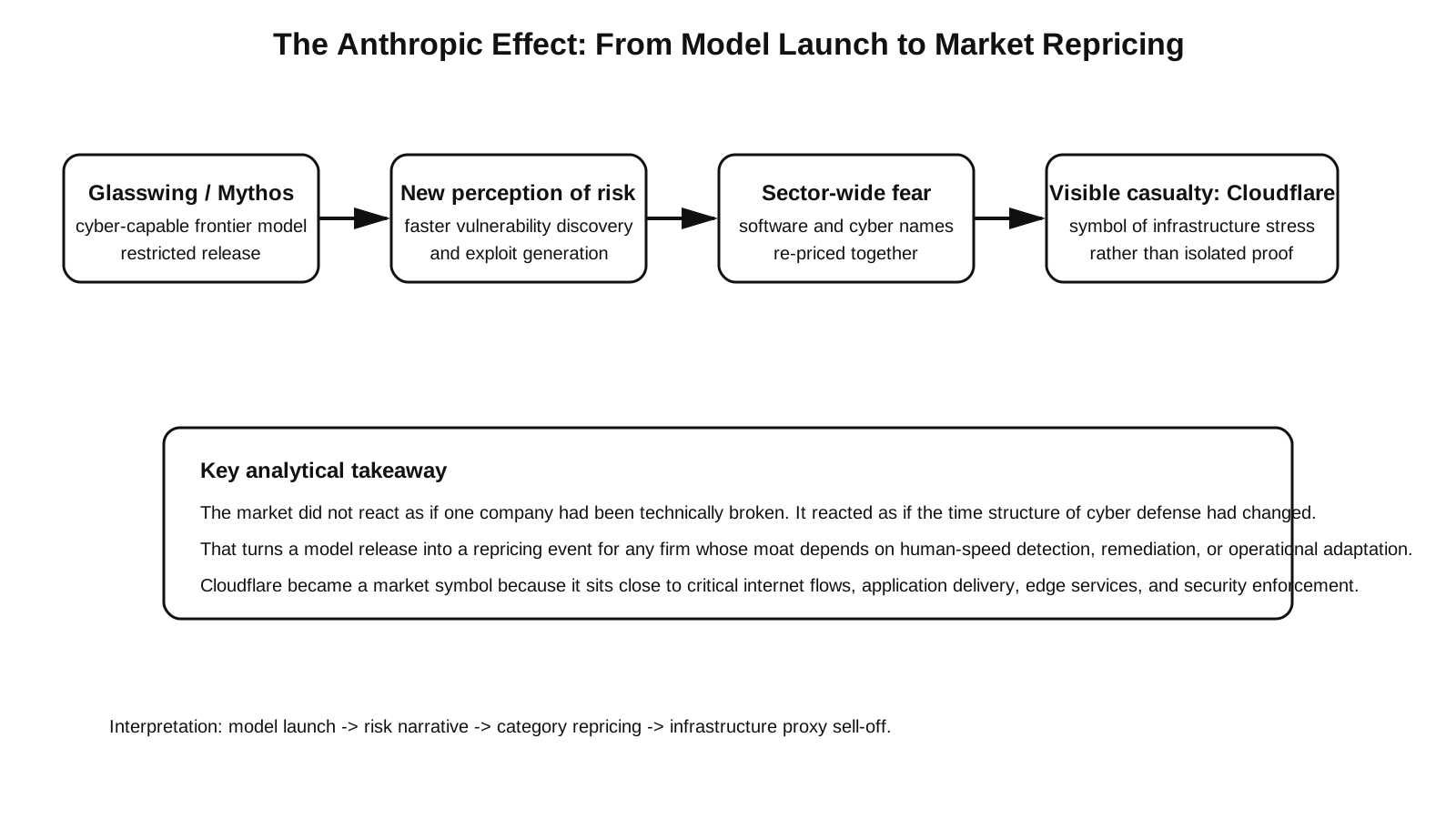
The sharp market reaction that followed Anthropic’s Glasswing announcement was not just another episode of hype around a new model. It was a glimpse of how frontier AI is starting to alter the economic logic of software, cybersecurity, and digital infrastructure. Cloudflare became one of the most visible casualties of that re-pricing, but the real story is broader. What moved markets was not a single stock, nor even a single product announcement. It was the sudden realization that AI may be collapsing the time gap between discovering a software weakness and turning that discovery into strategic pressure on the broader software stack.
This was not a normal product launch
Anthropic did not present Claude Mythos Preview as a routine improvement in coding or reasoning. In its own security-facing materials, the company described the model as unusually capable at identifying meaningful software weaknesses, to the point that broad public release was considered too risky. Access was limited to a defensive ecosystem of selected partners, and Anthropic explicitly argued that unrestricted availability would create an unacceptable threat profile.
That choice matters. The market has already grown used to increasingly strong claims around coding assistants, agentic workflows, and reasoning benchmarks. Glasswing landed differently because the implicit message was not simply that the model writes better code, but that it can materially accelerate security-relevant analysis. That is a higher-order statement. It forces investors to think not just about software productivity, but about software fragility.
A frontier model that can identify high-impact weaknesses across major systems changes the narrative from incremental automation to structural acceleration. Once that possibility enters the market’s imagination, the question immediately shifts. Investors stop asking which firms will adopt AI fastest and start asking which firms are exposed if pressure on the software stack starts compounding faster than the old defensive tempo.
Why Cloudflare was hit so hard
Cloudflare’s sell-off looked dramatic because the company occupies an outsized position in the digital stack. It is not merely a software vendor or a niche security firm. It sits on a large share of the world’s internet-facing traffic, application delivery, edge services, and security mediation. In other words, it is exactly the kind of company investors instinctively examine when the conversation turns from ordinary automation to systemic cyber acceleration.
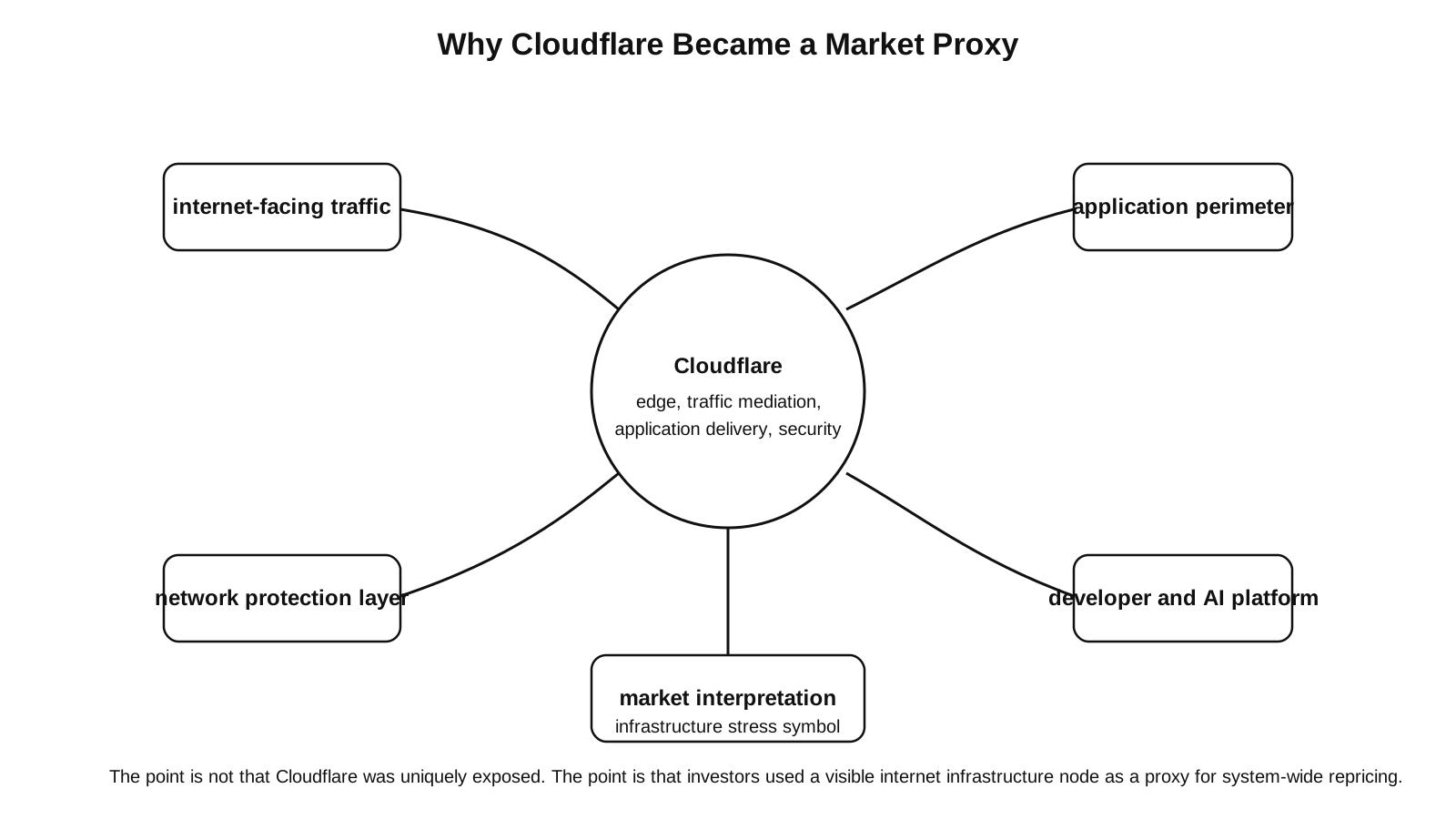
That does not mean Glasswing revealed a specific weakness in Cloudflare. There is no evidence that Anthropic exposed a direct flaw in Cloudflare’s products or architecture. But markets often move before such evidence exists. What matters first is perceived category risk. Cloudflare is large enough, visible enough, and central enough to become a proxy for a bigger concern: if AI can sharply improve software analysis and compress the defensive timeline, how should investors value companies whose reputations depend on being resilient nodes in a rapidly changing environment?
That is why the drop should not be read as a verdict on Cloudflare alone. It is better understood as a stress signal. The market treated Cloudflare as one of the first high-profile places where AI-era cyber anxiety could be expressed in price.
The market was re-pricing a sector, not just a company
One of the easiest mistakes in interpreting this episode is to reduce it to a simple cause-and-effect headline: Anthropic launched Mythos, so Cloudflare fell. That version is too neat. The broader evidence points to a wider software and cybersecurity sell-off rather than an isolated reaction to one firm.
That distinction matters because it changes the thesis. If only Cloudflare had sold off, the story might have been about company-specific vulnerability, competitive pressure, or sentiment excess. But when multiple software and cyber names fall together, the market is saying something different. It is expressing fear that AI is compressing advantages that once looked stable across the sector.
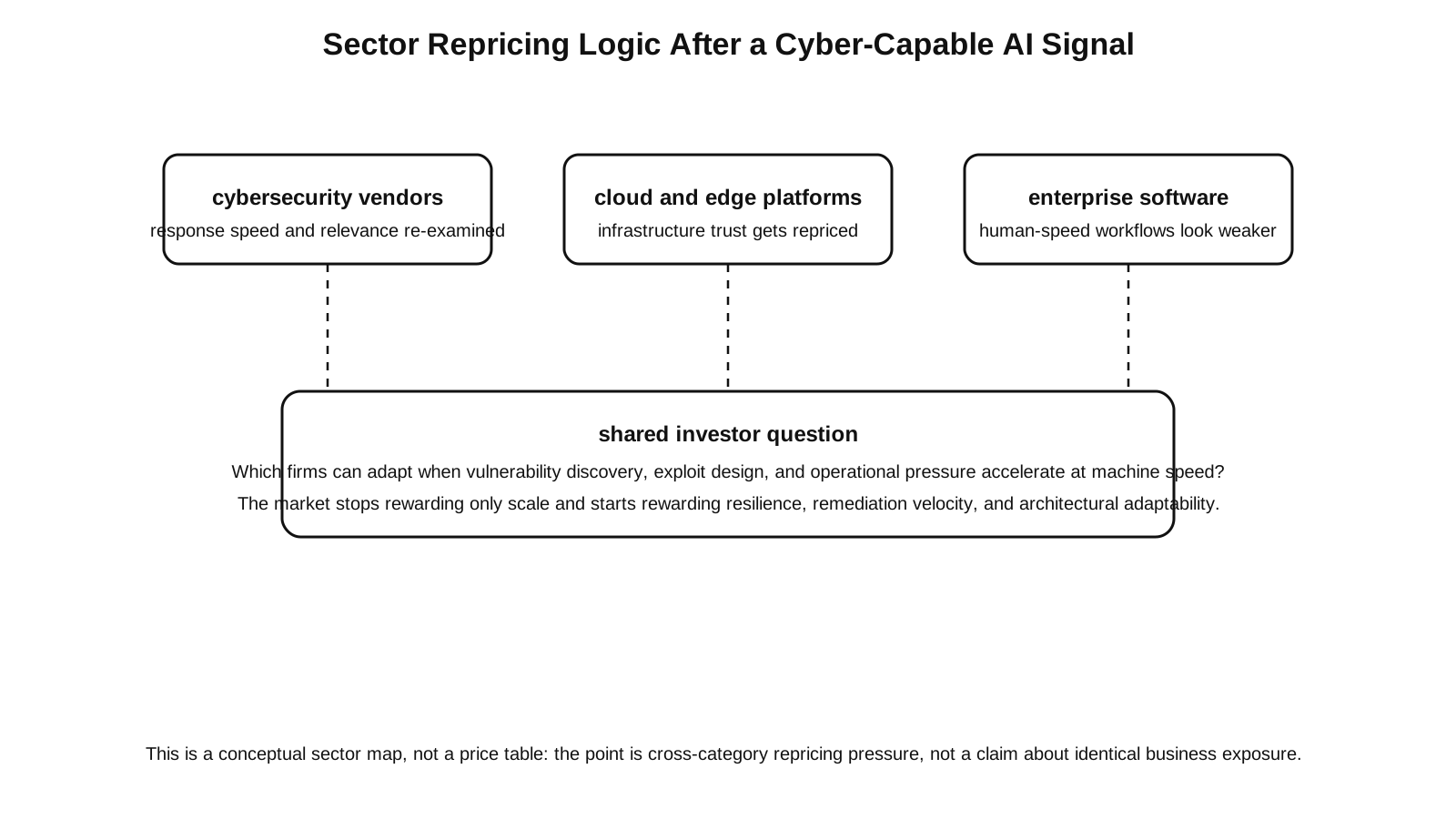
The old valuation framework for many software companies rested on a comfortable combination of recurring revenue, sticky enterprise customers, scale advantages, and a belief that security spending is structurally durable. In an AI-accelerated world, those ingredients may still matter, but they are no longer sufficient on their own. Investors increasingly want to know whether a company can survive faster pressure cycles, AI-assisted attack tooling, and the shrinking relevance of workflows that depend on human speed.
The real shock: AI is changing the economics of time
The most important concept in this story is not the model itself. It is time.
Cybersecurity has always been shaped by timing: time to discover, time to patch, time to respond, time to recover. Entire defensive strategies are built around creating friction between these stages. That friction is valuable. It gives defenders room to detect, prioritize, remediate, and contain.
What Glasswing and Mythos implied is that frontier AI may be eroding that buffer. If a model can compress the path from code analysis to operational pressure, then the defender’s margin for error narrows. Processes that once functioned adequately on a timescale of weeks or months may become dangerously slow if the relevant window shrinks to days, hours, or even minutes.
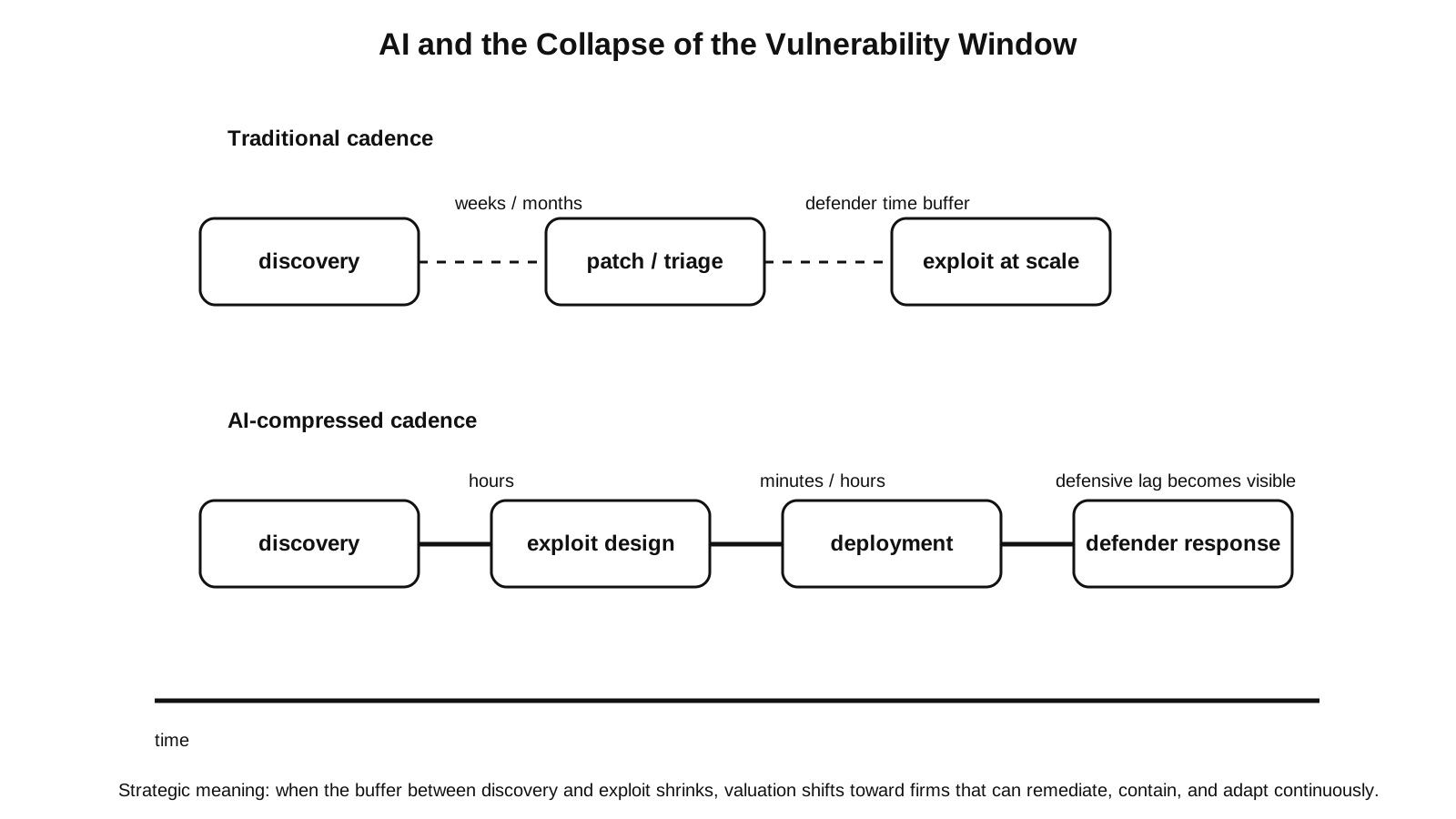
This is why the market reaction felt so disproportionate. Investors were not just pricing in a stronger model. They were pricing in a world where the clock itself runs differently.
Once that happens, value starts to migrate. It moves away from abstract promises of being AI-enabled and toward concrete operational capabilities: rapid remediation pipelines, automated code review, runtime containment, identity-centric controls, resilient software supply chains, and organizations capable of treating security as a continuous adaptive loop rather than a periodic human-led function.
Cloudflare’s paradox: exposed and advantaged at the same time
Cloudflare is an especially interesting case because it sits on both sides of the story.
On one side, it is vulnerable to investor anxiety precisely because it is so central. Companies that mediate traffic, secure applications, sit at the edge, and handle critical delivery paths inevitably attract scrutiny when systemic risk is being re-priced. Their very scale makes them sensitive to fear.
On the other side, Cloudflare is also positioned to benefit from the same transition. It has already been investing in AI-related infrastructure, model inference at the edge, application security, and developer-facing AI tooling. In principle, the rise of AI-driven cyber risk should increase demand for intelligent filtering, adaptive policy enforcement, traffic inspection, and AI-aware security layers.
This creates a paradox. The same shift that makes the market nervous about Cloudflare could also expand the strategic importance of exactly the kinds of services Cloudflare provides. That tension is why sharp price moves in moments like this should be interpreted carefully. They often reflect a violent repricing of uncertainty, not a settled conclusion about long-term winners and losers.
Why the Trump factor is real, but not the whole story
There is also a political layer to this episode. Anthropic had already attracted additional attention because of earlier conflict involving Donald Trump and his administration. That media heat likely amplified the visibility of anything the company released afterward. Political conflict is often free advertising, especially when it centers on a fast-rising AI company.
But it would be an overreach to claim that angry Trump posts or Truth Social rhetoric directly caused the sell-off in Cloudflare or the wider software sector. At most, politics added attention and narrative intensity. The real market-moving force appears to have been the substance of the Glasswing announcement and the fear that advanced cyber-capable AI could challenge existing assumptions about software durability.
In other words, politics may have increased the volume. It did not write the score.
What investors suddenly understood
The deeper meaning of the Anthropic effect is not that one lab can destroy incumbents overnight. It is that AI is beginning to attack one of the market’s most comfortable assumptions: that traditional software niches remain defensible on familiar timelines.
For years, many technology categories benefited from a kind of narrative inertia. If a company had scale, enterprise distribution, recurring revenue, and a plausible security or infrastructure moat, the market could justify paying richly for stability plus growth. AI disrupts that comfort because it does not simply create new products. It changes the velocity at which weaknesses are found, copied, pressured, and defended against.
That means companies are increasingly judged not only by what they sell, but by how quickly their architecture, governance, response loops, and operational defenses can evolve under machine-speed pressure. The moat is no longer just code, customers, or market share. The moat becomes adaptability.
What comes next
This is unlikely to be a one-off event. More episodes like this are probable, and not only because of Anthropic. As frontier AI systems become better at software reasoning, code execution, agentic workflows, and cyber tasks, the market will repeatedly revisit the same question across many categories: which companies are genuinely AI-native in their resilience, and which ones are still being valued as if the old clock remains in effect?
That question will not stop at cybersecurity. It can spread across cloud tooling, developer platforms, enterprise SaaS, observability, identity, software supply chain vendors, and any business whose value proposition depends on human-paced detection or response.
The result will be recurring volatility, but also recurring clarification. Every such episode helps reveal which companies are merely adjacent to AI and which are prepared to operate inside an AI-compressed environment.
Final view
The most useful interpretation of the Anthropic effect is neither sensational nor dismissive.
It is not that Anthropic killed Cloudflare. It is not that one model suddenly made established infrastructure companies obsolete. And it is not just another cycle of exaggerated AI hype.
What happened is more consequential. The market briefly saw a future in which the economics of cyber defense, software trust, and digital infrastructure are governed by machine-speed discovery and machine-speed operational pressure. Once investors glimpse that future, even imperfectly, prices move.
Cloudflare happened to be one of the clearest symbols through which that anxiety could be expressed. But the repricing was never really about Cloudflare alone. It was about a new and uncomfortable possibility: that AI is not merely automating work inside the software economy. It is beginning to rewrite the conditions under which the software economy itself can be defended.
Sources
-
Anthropic Glasswing announcement: anthropic.com/glasswing
-
Anthropic Mythos Preview security write-up: red.anthropic.com/2026/mythos-preview
-
Reuters on software-sector sell-off: reuters.com
-
Reuters on the earlier Trump-Anthropic conflict: reuters.com
-
Cloudflare company overview and web traffic framing: cloudflare.com/what-is-cloudflare