AI-First Software Delivery and the New Geometry of Control
Source asciidoc: `docs/article/zz-ai-first-software-delivery-and-the-new-geometry-of-control.adoc`
AI-first delivery changes more than developer productivity. As implementation becomes cheaper, the hidden cost of coordination becomes easier to see. That shifts competitive advantage away from raw coding capacity and toward controllability: the ability to translate product intent into reliable production change with minimal distortion.
For years, most product and engineering leaders treated software delivery as a scaling problem. The default question was how to add more capacity, more specialization, and more process without losing too much speed. Frontend, backend, mobile, QA, DevOps, product, and management each occupied a visible place in the chain. That structure was rational when code production was the main bottleneck and the cost of execution justified repeated handoffs.
AI changes that equation.
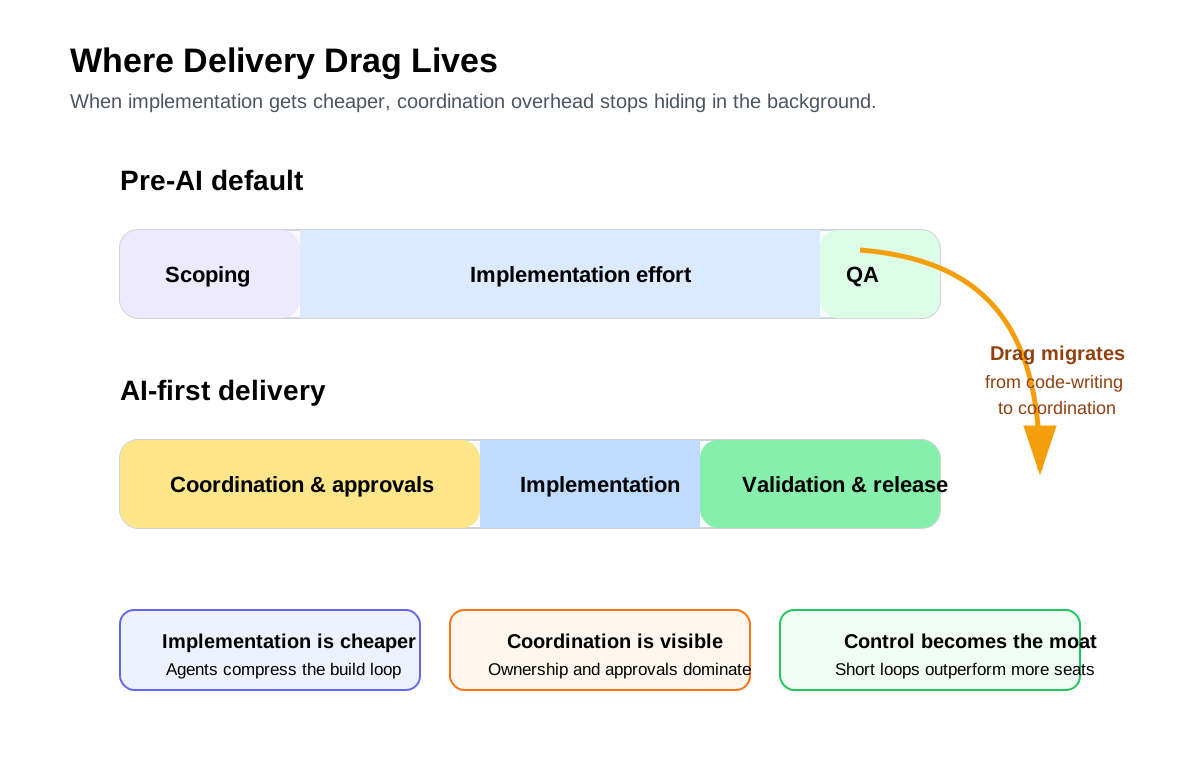
The shift is not simply that code can now be written faster. The deeper shift is that the center of gravity moves away from raw implementation effort and toward management quality: problem framing, architecture choice, validation, guardrails, and operational discipline. Once the marginal cost of execution drops, the hidden cost of coordination becomes much easier to see. In many small companies, that cost is now the dominant drag on delivery.
From acceleration requests to operating-model redesign
Only a few years ago, many leadership teams approached AI and automation as productivity upgrades. They wanted faster implementation, lighter process, and more self-service. No-code, low-code, and developer tooling were framed as ways to make existing teams somewhat more efficient.
That is no longer the whole story. Increasingly, the strategic question is not how to help the current organization move a little faster, but how to redesign the organization around AI-native execution. The practical question has changed from “How do we speed up development?” to “How do we operate with fewer handoffs, a smaller core team, and much higher output per engineer?”
This change is consistent with broader market signals. Google Cloud’s 2025 DORA research reported near-universal workplace AI usage among respondents and strong perceived productivity gains, while also documenting continued skepticism around generated code. [dora] Stack Overflow’s 2025 Developer Survey points in the same direction: AI use is now deeply embedded in developer workflows, and daily usage is no longer exceptional. [stackoverflow]
What changes, then, is not just the toolchain. The optimal organizational shape changes as well.
Why coordination becomes the expensive part
In classical software organizations, specialization was a way to reduce uncertainty. Separate teams, approval layers, and formalized handoffs helped distribute work across skills that were genuinely scarce. The result was slower, but often safer. When the implementation loop was expensive, the coordination tax could be tolerated.
AI compresses the implementation loop. A strong engineer with good context, assisted by agentic tooling, can explore a codebase, draft changes, run tests, generate migration paths, and prepare release candidates far more quickly than before. Anthropic describes Claude Code as an agentic coding tool that can read a codebase, edit files, run commands, and integrate with development workflows. [claudecode] OpenAI describes Codex in similar terms, including multi-agent workflows, isolated worktrees, and long-running tasks. [codexapp][codexdocs] The common pattern is clear: the model is no longer just autocomplete. It is part of the execution machinery.
Once this happens, the real bottleneck often moves upstream and sideways. It lives in conflicting priorities, unclear ownership, unnecessary review surfaces, overloaded rituals, approval latency, and context loss between business intent and technical action. As execution becomes cheaper, coordination becomes more visibly expensive.
This is why many small firms experience AI not merely as a developer productivity tool but as a pressure test of their management architecture. The question stops being whether the team can produce code. The question becomes whether the company can turn intent into validated production change without drowning in process overhead.
Controllability, not just speed
Speed is an outcome. Controllability is a property.
A company can move fast in a chaotic way. The more durable advantage is not raw acceleration, but a tighter path from product decision to shipped change. That is the central management implication of AI-first delivery.
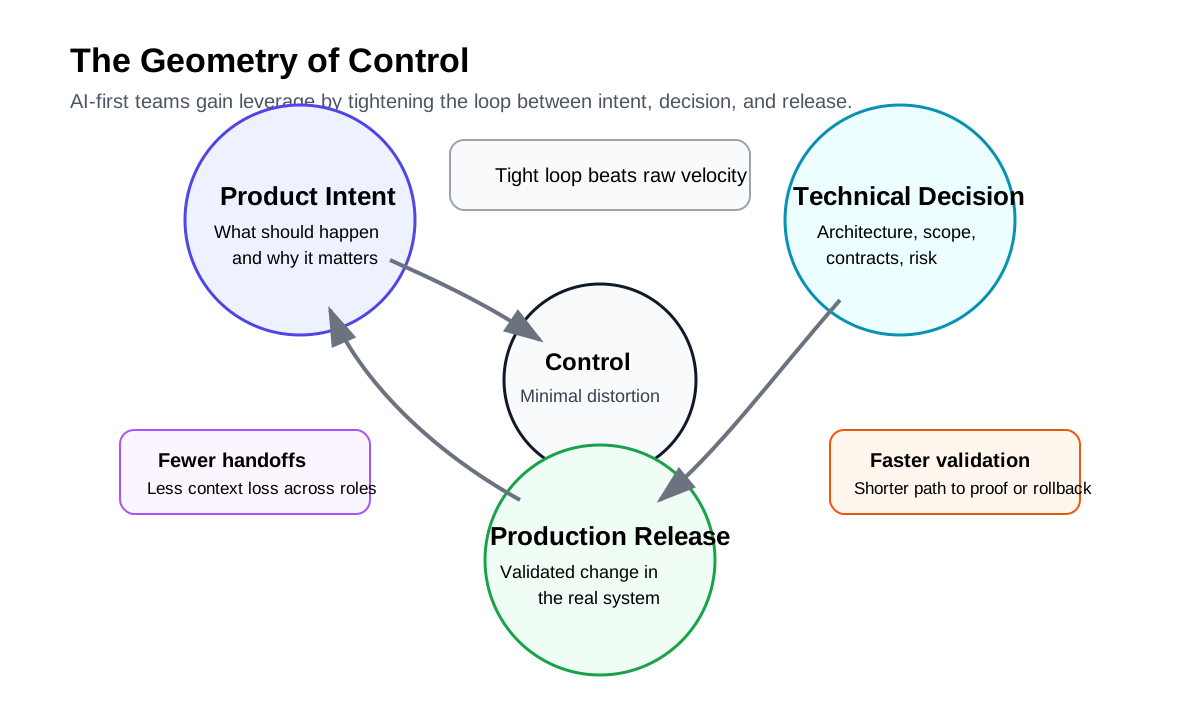
In an AI-first setup, the strongest teams reduce the distance between three points:
-
product intent
-
technical decision
-
production release
When these points are tightly coupled, leaders gain something more valuable than simple velocity. They gain control over the delivery loop. Strategy is translated into implementation with fewer distortions, fewer meetings, and fewer interpretation layers.
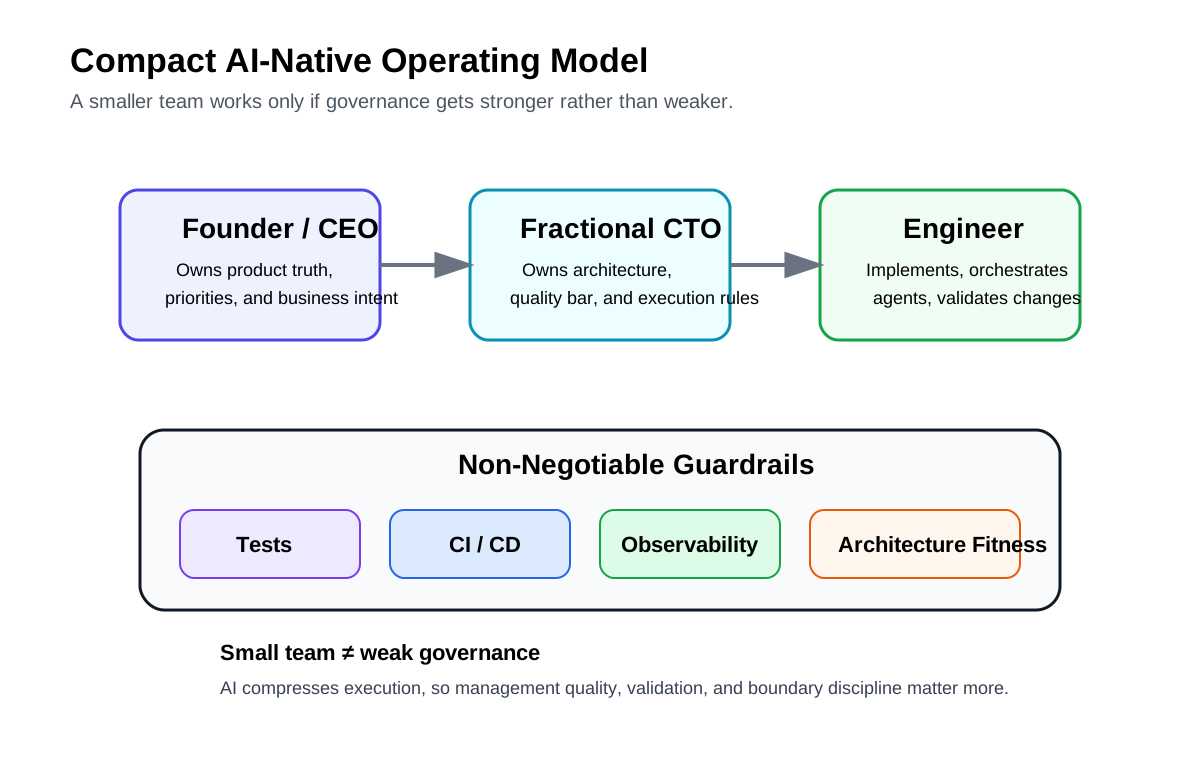
This is where a compact structure often outperforms a larger one. For many startups and small product businesses, an emerging pattern is simple: founder or CEO for product intent, a strong fractional or embedded CTO for system design and execution governance, and a small number of engineers who operate with high autonomy inside clear constraints. This model works not because AI makes human judgment irrelevant, but because it makes judgment more valuable. When execution becomes cheaper, the premium shifts to choosing the right architecture, the right scope, the right abstractions, and the right release discipline.
Sequoia Capital recently framed a related shift at the market level: the next generation of winners may look less like software vendors selling tools and more like software-driven firms selling completed work. [sequoia] The same logic applies inside product companies. As intelligence becomes cheaper, management systems that reduce coordination distance become disproportionately powerful.
The compact AI-native operating model
The compact model should not be described as “one engineer replacing an entire department.” That is too simplistic and often false. A better description is that AI allows a smaller team to cover a wider execution surface, provided the company redesigns governance around that reality.
The founder still owns product truth. The technical lead still owns architecture, production safety, system boundaries, and the quality bar. The engineer still owns implementation, but implementation now includes much more orchestration: directing agents, validating generated work, tightening contracts, and maintaining delivery momentum across the stack.
This is why the role of a fractional CTO becomes especially valuable in AI-first companies. AI can compress execution, but it does not automatically generate sound architecture, deployment discipline, test strategy, observability, or rollback logic. In fact, the faster the implementation loop becomes, the more dangerous weak governance becomes. Thoughtworks, commenting on the 2025 DORA findings, put the point clearly: without the right structure and processes, AI becomes a faster way to create chaos. [thoughtworks]
AI-first delivery is not the abolition of engineering leadership. It is the opposite: a stronger demand for engineering leadership concentrated at the system level rather than distributed across a large hierarchy.
Why some stacks and repo shapes win
If AI changes execution economics, technology choice starts to change as well. GitHub’s recent writing on Octoverse 2025 argues that AI compatibility is becoming a meaningful factor in developer technology preference. [githuboctoverse] This does not mean there is one mandatory stack, but it does mean that some environments are more legible to models, easier to refactor safely, and easier to validate automatically than others.
The practical implication is straightforward. Small AI-native teams tend to benefit from stacks with strong conventions, good tooling, explicit contracts, reliable test surfaces, and repository structures that support large-context reasoning. In many cases, they also benefit from keeping more of the delivery surface in a single repository or a tightly governed set of repositories, because fewer boundaries mean fewer integration delays and fewer context switches for both humans and models.
That said, monorepo should not be treated as dogma. It is often an accelerator for small teams, not a universal law. The real principle is coherence. AI works best when code, contracts, infrastructure intent, tests, and operational signals are close enough to be reasoned about together.
The non-negotiable guardrails
The compact AI-native model only works when the company invests in control surfaces.
The first control surface is testing. Not just unit coverage, but integration paths that confirm business-critical behavior and catch model-produced regressions. The second is CI/CD discipline: deterministic validation, clear promotion paths, and reversible releases. The third is observability: logs, metrics, traces, alerts, and fast diagnosis after change. The fourth is architectural fitness: typed boundaries, explicit interfaces, reviewable contracts, and limited ambiguity in ownership.
These are not optional additions to AI-first work. They are the price of making a smaller team trustworthy at higher speed.
Where the model breaks
The compact AI-first structure is not universal.
Heavily regulated domains, safety-critical systems, large enterprise dependencies, politically layered organizations, and products with severe cross-team coupling may still require broader structures and slower governance. Legacy estates with poor tests, undocumented behavior, and fragmented ownership can also neutralize much of AI’s leverage. In these environments, the first job is often not acceleration, but system cleanup and boundary repair.
Even in smaller companies, the model fails when leaders confuse lower execution cost with lower architecture cost. Cheap code is not the same as cheap correctness. Cheap implementation is not the same as cheap reliability. If anything, AI raises the importance of deliberate design because it makes it easier to manufacture complexity at high speed.
Conclusion
The most important change in software delivery is not that AI writes code. It is that AI changes the optimal geometry of control.
When execution becomes cheaper, coordination overhead stops hiding in the background and starts showing up as the main source of waste. Companies that redesign around a tighter product-to-production loop gain something more important than speed: a more controllable system.
That is why the strongest AI-first organizations are not simply developer teams with better tools. They are management systems rebuilt around shorter loops, clearer ownership, stronger technical governance, and a delivery model in which a small number of high-context people can move with unusual force.
The next competitive advantage is not intelligence alone. Intelligence is becoming cheaper. The durable advantage is the ability to convert intent into reliable production change with minimal distortion.
Editorial illustration notes
The SVG diagrams bundled with this article are original editorial visuals created for this piece. They are schematic by design and are intended to clarify the argument rather than reproduce third-party charts.
-
ai-control-geometry.svg— the controllability loop between product intent, technical decision, and production release. -
ai-coordination-economics.svg— a schematic view of delivery drag shifting from implementation effort toward coordination overhead. -
ai-compact-operating-model.svg— the compact operating model and the guardrails required to keep it trustworthy.
References
-
[] Google Cloud Blog, Announcing the 2025 DORA Report.
-
[] Stack Overflow, 2025 Developer Survey: AI.
-
[] Anthropic Docs, Claude Code overview.
-
[] OpenAI, Introducing the Codex app.
-
[] OpenAI Developers, Codex.
-
[] Sequoia Capital, Services: The New Software.
-
[] Thoughtworks, The 2025 DORA Report.
-
[] GitHub Blog, How AI is reshaping developer choice.